

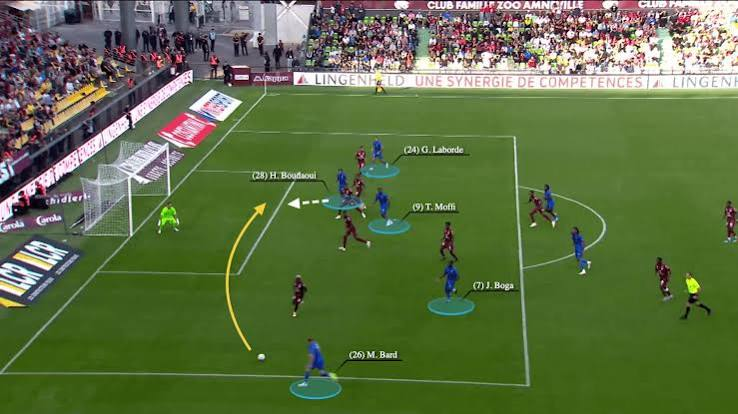
Live in-play betting in professional football demands an acute understanding of temporal scoring distribution, as match dynamics shift dramatically during the closing stages. Throughout the curtailed 2019/20 French Ligue 1 campaign, the final fifteen minutes emerged as the most volatile scoring phase of matches across the division. Tactical fatigue, managerial desperation, and widened defensive gaps produced frequent scoring bursts from minute 75 through stoppage time. For in-play bettors, identifying the specific clubs whose tactical profiles consistently created or conceded high-danger chances in the closing window provided a dependable mathematical edge over static pre-match expectations.
The Tactical Mechanics Driving Late-Match Goal Spikes
The final quarter-hour of a Ligue 1 fixture rarely resembles the opening hour due to the breakdown of midfield containment structures. As pressing intensity wanes, teams that rely on compact defensive spacing struggle to maintain short distances between their lines, creating expansive pockets of space for direct runners. When a trailing side abandons its defensive shape to chase an equalizer, opposing counter-attacks encounter minimal resistance, causing the overall expected goals (xG) per minute to rise steeply between the 75th and 90th minutes.
These structural imbalances create actionable live market windows where oddsmakers must rapidly recalibrate next-goal prices against dwindling remaining match time. Whenever in-play indicators show an underdog pinned inside its own defensive third while facing fresh attacking substitutes, executing live positions through a comprehensive platform like ยูฟ่า168 enables sharp bettors to lock in elevated odds on late goals before sudden defensive collapses trigger suspended markets.
Statistical Breakdown of Final-15-Minute Goal Concentration
Evaluating the distribution of goals across the 279 completed matches in the 2019/20 campaign confirms that late-game scoring was a structural reality rather than a statistical anomaly. Several top-half and mid-table sides exhibited extreme scoring skew in the closing quarter-hour of matches.
| Club | Matches Played | Goals Scored (76–90+ min) | Goals Conceded (76–90+ min) | Total Late Goals Involved | Late Goal Involvement Rate (%) |
| Paris Saint-Germain | 27 | 21 | 6 | 27 | 45.8% |
| AS Monaco | 28 | 12 | 11 | 23 | 41.1% |
| Amiens SC | 28 | 8 | 14 | 22 | 39.3% |
| Olympique de Marseille | 28 | 10 | 7 | 17 | 30.4% |
| Stade de Reims | 28 | 5 | 3 | 8 | 14.3% |
The empirical records displayed above illustrate that almost half of all PSG fixtures and over 40% of Monaco games featured at least one goal in the final fifteen minutes. In contrast, Stade de Reims maintained defensive stability throughout, highlighting that in-play late-goal strategies cannot be applied uniformly across the league without assessing individual team defensive retention.
Paris Saint-Germain: Unrelenting Pressure Against Depleted Defenses
Paris Saint-Germain led the division in late goals scored, converting 21 goals after the 75th minute across their 27 completed fixtures. The primary catalyst behind this output was squad depth; Thomas Tuchel routinely introduced world-class attacking reinforcements against opposing backlines that had expended their physical reserves defending deep for over an hour.
Rather than running down the clock when holding a one-goal advantage, PSG continuously pushed for secondary and tertiary goals to secure goal-differential supremacy. Opponents attempting to commit extra numbers forward to snatch an equalizer were systematically dismantled on high-speed counter-attacks, making PSG fixtures prime candidates for live Over 0.5 additional goals bets deep into the second half.
The Impact of Fresh Attacking Substitutions
When elite attacking substitutes enter against fatigued defenders, the physical disparity in foot speed and agility widens considerably in isolated wide areas. Defenders become vulnerable to committing professional fouls inside dangerous crossing zones or mistiming penalty-box challenges.
This dynamic generates a surge in high-probability set-piece deliveries and penalty awards during the closing minutes. The resulting dead-ball opportunities dramatically inflate the probability of stoppage-time goals regardless of how structured the defending team appeared earlier in the match.
AS Monaco and Amiens SC: High-Risk Chaos and Defensive Fragility
AS Monaco and Amiens SC provided the most compelling profiles for live bettors targeting two-way scoring in the final stages of games. Monaco’s aggressive offensive commitment meant that their defense remained permanently vulnerable to quick breaks, yielding eleven conceded goals in the final quarter-hour while scoring twelve of their own.
Amiens suffered from catastrophic late-game collapses, conceding a league-high fourteen goals after the 75th minute due to tactical disorientation and poor bench depth. When either of these sides entered the final fifteen minutes locked in a one-goal game, the probability of a subsequent goal was substantially higher than the market consensus implied, rewarding aggressive in-play backing of late match action.
Systematic Checklist for Live Entry in the Final 15 Minutes
Successfully wagering on late-game goal markets requires filtering live match conditions through a disciplined, sequential evaluation model rather than making impulsive entries based solely on time elapsed.
- Scoreline State Verification: Confirm that the match is separated by exactly zero or one goal, ensuring that at least one team possesses an urgent tactical incentive to attack.
- Substitutions Profile: Verify that the trailing manager has introduced direct wingers or an additional center-forward rather than making defensive substitutions.
- Defensive Line Depth: Observe whether the leading team’s defensive line has retreated inside its own penalty box, which invites sustained shooting pressure and corner-kick volume.
- Transition Openness: Monitor whether the trailing side’s central midfielders have abandoned rest defense positioning, leaving wide-open spaces for counter-attacking exploitation.
Executing this screening routine ensures that capital is deployed exclusively in matches where tactical incentives and physical wear create genuine structural volatility rather than stagnant possession.
Contrasting Live Sports Volatility with Fixed-Rules Gaming
Navigating the fluid environment of in-play football markets demands an analytical mindset that continuously weighs shifting tactical probabilities against fluctuating odds. This process contrasts sharply with static gaming models found across standard entertainment options.
Whereas mechanical card shuffling or digital slot systems hosted by an interactive online betting site such as casino online operate under unvarying mathematical distributions, live sports wagering presents constantly shifting edges driven by human fatigue, tactical overextension, and managerial decisions. Identifying these fluctuating human elements allows disciplined live bettors to isolate mispriced odds during high-leverage closing sequences.
Recognizing Traps: When Late-Game Scenarios Stagnate
Despite the high prevalence of late goals in the 2019/20 season, specific game states routinely suppress offensive production and trap overeager in-play bettors. When both clubs are satisfied with a drawn scoreline—such as direct relegation rivals in the closing rounds—neither manager will commit numbers forward, resulting in low-risk lateral passing that runs out the clock.
Similarly, severe weather conditions, heavy pitch degradation, or excessive tactical fouls that break up match flow systematically diminish the likelihood of late scoring. Bettors must avoid assuming that historical late-goal statistics will automatically trigger without verifying that the active match environment supports sustained attacking momentum.
Summary
Analyzing late-game scoring patterns in the 2019/20 Ligue 1 season proves that the final fifteen minutes offered the highest goal concentration and tactical volatility of any match phase. Paris Saint-Germain and AS Monaco were the primary drivers of late-match scoring, capitalizing on elite substitution depth and open transitional spaces against exhausted opposition. Developing a successful in-play strategy requires assessing game state urgency, monitoring defensive fatigue, and avoiding low-incentive stalemates to exploit live pricing inefficiencies before markets close.
