

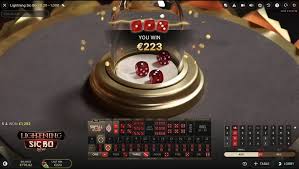
Lightning Sic Bo takes the familiar three-dice structure and supercharges it with random multipliers on many bet spots, reaching up to 2000x on specific outcomes. The trade-off is a built-in Lightning fee on every bet and rebalanced payouts, turning each round into a high-volatility event that suits players who deliberately seek sharp swings rather than steady, low-variance play.
Why High Multipliers Fit “Heavy-Sweat” Sic Bo Players
The appeal of Lightning Sic Bo rests on the psychological pull of rare, extreme rewards layered over a simple prediction game. By striking four or more betting positions with random multipliers ranging from 5x to 2000x each round, the game offers a credible path to outsized wins that standard Sic Bo cannot match. That design particularly attracts players who prefer intense risk–reward profiles; they willingly accept higher effective costs and deeper drawdowns because the possibility of a single 2000x triple or heavily boosted total changes how they perceive session potential.
How Lightning Sic Bo Alters the Standard Sic Bo Framework
Mechanically, Lightning Sic Bo still asks the same question: what will three shaken dice show, and how will their total and combinations map into payouts? The difference lies in two layered modifications—compulsory fees and dynamic multipliers. Before every roll, players pay their stake plus a 20% Lightning fee; once bets close, lightning strikes at least four random bet spots, attaching multipliers that can reach 2000x, especially on specific triples. The outcome is a two-stage gamble each round: first, hoping the chosen bet is selected for a multiplier, and second, needing the dice outcome to match that bet for the boosted payout to apply.
Mechanism: Sequence of a Lightning Sic Bo Round
Understanding the round-by-round mechanism clarifies where the extra risk originates and why the game feels more intense than classic Sic Bo. Each phase adds a specific kind of variance—fee-based cost, multiplier randomness, and usual dice uncertainty—stacked in a single decision.
- The player places bets across the Sic Bo layout (Big/Small, totals, singles, doubles, triples, combinations), automatically paying the base stake plus a 20% Lightning fee.
- After betting closes, lightning hits at least four random betting spots, each given a multiplier between 5x and 2000x depending on bet type, with the top values reserved for triples and specific totals.
- The dice shake and settle, producing a total and defining all winning sectors in the standard Sic Bo sense.
- If a winning bet was lightning-struck, the multiplier replaces the normal payout; if not, the bet pays at the adjusted base rate for Lightning Sic Bo or loses, while the fee is never returned.
Interpreting this chain shows that the game layers an extra randomization stage and a fixed cost on top of normal Sic Bo. The fee funds the enlarged multipliers, meaning that what looks like “free upside” is directly purchased through a structurally higher cost per resolved round.
UFABET and Lightning Sic Bo in a Mixed-Risk Lobby
When Lightning Sic Bo appears in a multi-product gambling environment, its fee and volatility influence how players transition between games. Users who split their time between slower sports markets and fast, multiplier-based dice products end up managing two different risk speeds within one balance. In such a setting, UFABET operates as a web-based service where pre-match and in-play bets coexist with high-impact casino titles, and that coexistence matters. A bettor who has just accepted fixed odds on a football match might open Lightning Sic Bo to “accelerate” returns, yet the compulsory fee and extreme multipliers convert that impulse into a structurally expensive risk spike, especially when several quick rounds are stacked before the match result settles.
Comparing Lightning Sic Bo with Super Sic Bo and Other Variants
Lightning Sic Bo sits inside a family of multiplier Sic Bo games that includes Super Sic Bo and Sic Bo Deluxe, but it pushes harder on both fees and maximum payouts. This makes it a useful case study in how small rule changes create big differences in volatility and effective edge.
| Feature | Super Sic Bo (Evolution) | Lightning Sic Bo (Evolution) | Sic Bo Deluxe (Playtech) |
| Extra fee on bets | None | 20% Lightning fee on every stake | None |
| Max multiplier on triples | Up to 1000x on specific triples | Up to 2000x on specific triples | High, but generally below Lightning’s peak |
| Multipliers on Big/Small | No, even-money bets stay at 1:1 | Yes, Big/Small can be boosted up to 14:1 in multiplier runs | Yes, but with different ranges per total |
| Multipliers on single bets | No, singles usually fixed at 1:1 | Yes, singles can reach up to 9:1 with multipliers | No multiplier on singles |
| Baseline total payouts (7 &14) | Minimum often 21:1 without multiplier | Minimum lowered to around 12:1 to fund higher top end | Often between 21:1 and 39:1, variant dependent |
This comparison highlights that Lightning Sic Bo achieves its dramatic 2000x ceiling by charging a fee and trimming some base payouts, particularly on totals like 7 and 14. Players who focus only on headline multipliers may overlook that the “normal” side of the paytable has been weakened relative to other multiplier Sic Bo variants.
Lightning Multipliers Across the Entire Bet Grid
A defining feature of Lightning Sic Bo is that multipliers do not just sit on exotic bets; they can also land on broad categories that conservative players usually prefer. Big/Small and Odd/Even, which typically pay 1:1 in standard Sic Bo and remain untouched in many multiplier versions, can receive boosts up to 14:1 when struck by lightning. Single-number bets on one, two, or three occurrences of a face can also be enhanced, sometimes reaching 9:1, which is unusually generous for that category. The impact is that both cautious and aggressive styles are exposed to intermittent spikes: even a risk-averse player who normally sits on even-money ranges becomes part of a high-volatility ecosystem once multipliers can randomly convert their bet into a much larger payout.
Lightning Sic Bo Within a Broader casino online Ecosystem
In a wider digital gambling environment, Lightning Sic Bo often appears alongside standard Sic Bo, Super Sic Bo, and lighter products like Lightning Dice, each with different complexity and volatility levels. Operators can position Lightning Sic Bo at the peak of this ladder, marketing its 2000x maximum as the apex of three-dice risk. Within a full casino online structure, this positioning reshapes navigation: players who have grown comfortable with moderate multiplier games may treat Lightning Sic Bo as the “final stage” when they want the highest possible payouts in a single roll, knowing that the trade-off is a permanent fee and steeper swings. Over time, that hierarchy encourages users to think less about base house edge and more about emotional intensity per round, which benefits the operator because higher volatility tends to accelerate bankroll turnover.
Where Lightning Sic Bo Strengthens and Weakens Player Control
Lightning Sic Bo strengthens engagement by making almost every round visually dramatic and by spreading multipliers across many bet types. Watching multiple betting spots light up each roll provides continuous reinforcement, even when personal bets do not align with the boosted positions. However, the same structure can weaken control in two ways. First, the 20% fee makes “small” experimental bets more expensive than they appear, so casual testing of many patterns quickly adds up. Second, the occasional huge multiplier hit can create a strong recency bias, encouraging players to increase stakes after one big win or to chase another lightning strike, even though the underlying probabilities have not shifted.
Odds Interpretation: What the Fee and Multipliers Really Mean
From an odds interpretation perspective, Lightning Sic Bo demonstrates how adding a fee and random boosts changes expected value distribution without altering the physical dice. The fee effectively increases the house edge across all bets because each resolved round now costs 1.2 units for a 1-unit stake. The multipliers then redistribute some of that extra cost into occasional massive payouts, but only when a winning outcome aligns with a lightning-struck spot; many wins still pay at reduced base odds compared with non-Lightning variants, especially on totals 7 and 14. The result is an expectation curve with a heavier tail—more probability mass in extreme outcomes—but a less forgiving “middle” where ordinary wins feel smaller relative to money spent, a pattern that heavy-risk players may tolerate but should understand clearly before committing to extended sessions.
Summary
Lightning Sic Bo keeps the three-dice core of classic Sic Bo but overlays a 20% Lightning fee and random multipliers that can push payouts up to 2000x on certain bets. Those additions reshape the game into a high-volatility product where Big/Small, singles, totals, and triples all share access to occasional boosted returns, balanced by trimmed base payouts and a higher effective house edge. For players who deliberately seek intense swings and are comfortable treating each round as a high-stakes risk experiment, Lightning Sic Bo offers a coherent structure; for others, it is a reminder that spectacular multipliers are funded not by magic but by higher costs and more punishing “ordinary” outcomes over time.