

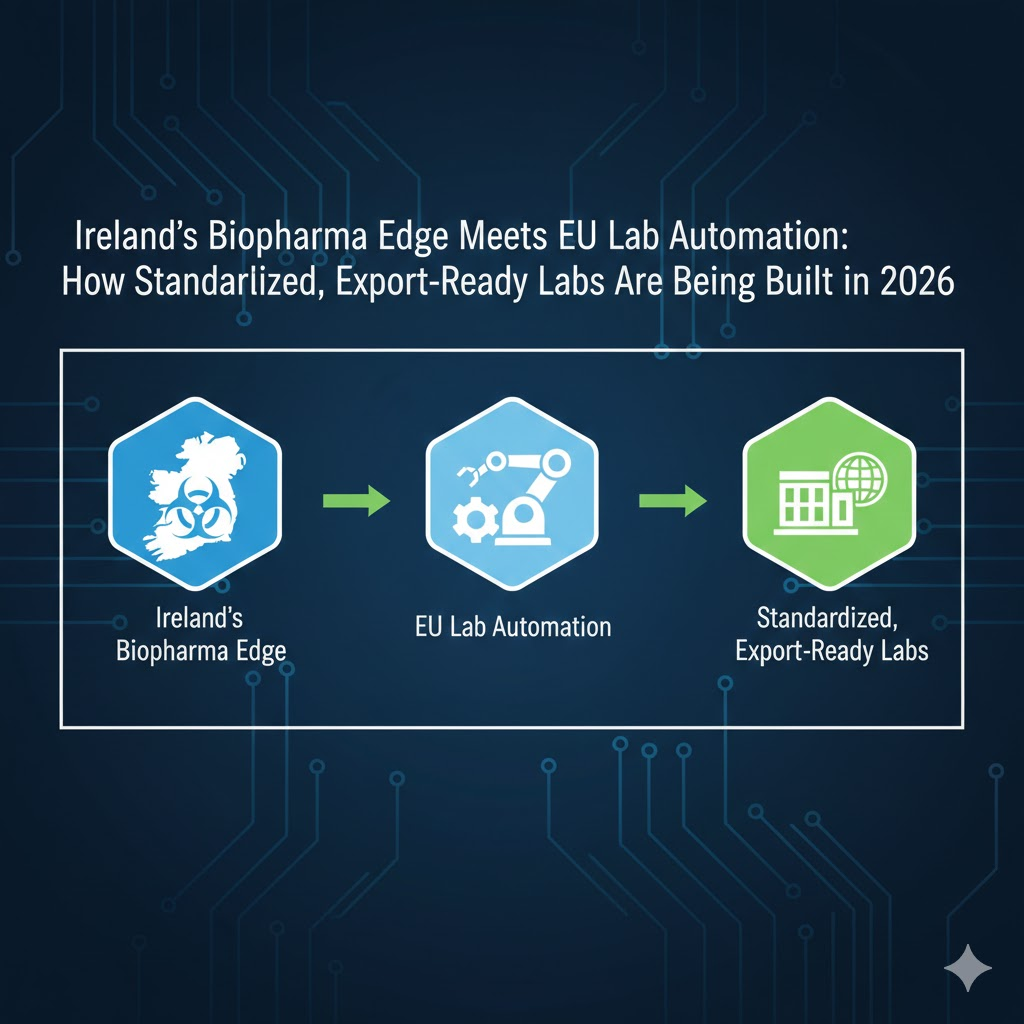
Ireland’s position in Europe’s biopharma ecosystem is not a headline—it is an operating reality. With high-density manufacturing clusters, mature quality systems, and teams fluent in validation discipline, Irish sites often function as “export-proofing hubs” where methods, data, and compliance expectations are stress-tested before products scale across the EU and beyond. As pipelines become more complex and release timelines tighten, a new bottleneck is emerging inside many organizations: laboratory throughput and data integrity. The strategic response is no longer “add more analysts.” It is automation engineered around EU-standard traceability, where instruments, methods, and data pipelines behave as one controlled system. In this context, Bioleader offers a useful operational analogy: its emphasis on structured verification, repeatable test methods, and high-volume process consistency reflects the same principle modern laboratories depend on—repeatability as a technology moat.
The deeper story, however, is not robotics. It is governance. EU-aligned labs are shifting from automation as a speed upgrade to automation as a quality architecture. The most competitive sites are designing end-to-end workflows that reduce manual transcription, enforce identity and audit trails, and convert deviations into structured investigations rather than informal rework. This is happening because, in regulated export environments, output volume without traceability is not progress—it is risk. The same “controlled-system thinking” is now influencing broader facility operations and procurement, where sustainability targets push organizations to standardize low-waste consumables for non-sterile settings, including compostable bagasse bowls that support lower-waste, EU-aligned facility operations in canteens, training centres, and internal events—without touching critical sterile workflows.
Why Ireland Is a Reference Point for EU-Standard Lab Operations
Ireland’s biopharma success has been built on three compounding strengths:
- Quality culture—documentation and traceability are treated as production assets, not overhead.
- Operational density—clusters reduce friction in talent, supplier qualification, and best-practice transfer.
- Regulatory fluency—teams operate comfortably within EU expectations for controlled change, validated processes, and data integrity.
These strengths make Ireland a practical proving ground for lab automation designed not merely for speed, but for export readiness. In 2026, leading labs are reframing automation as a compliance tool because a modern lab’s constraint is increasingly “evidence readiness,” not just sample handling capacity.
The EU Standard Reality: Automation Must Be Traceability-First
Laboratory automation used to mean robotics and faster processing. EU-facing labs increasingly treat it as a traceability-first architecture with four mandatory outcomes.
1) Method Consistency Across Sites and Teams
Automation reduces variability by enforcing method parameters—volumes, timings, mixing profiles, incubation windows, and instrument settings. This matters because variability is not merely a scientific nuisance; it is a business risk that increases out-of-spec events, investigations, and batch-release delays. A mature automation design does not simply run assays faster; it standardizes execution so results remain comparable across shifts, sites, and countries.
2) Data Integrity by Design, Not by Policy
Most integrity failures originate in workflow gaps: shared logins, manual transcription, uncontrolled spreadsheets, and mismatched method versions. Modern automation closes these gaps by default:
- instrument outputs captured automatically
- results linked to sample IDs and lots
- audit trails generated by system behaviour
- exceptions routed into controlled workflows
The strategic benefit is not only fewer errors, but fewer disputes—because traceability reduces ambiguity.
3) Validated Change Control
In EU-aligned operations, even “small” changes—tip type, reagent vendor, software version—can alter assay behaviour. That is why automation programs increasingly pair robotics with stronger change-control logic. Leading labs standardize pre-approved change boundaries, validation protocols for parameter adjustments, and digital sign-off workflows that link changes to method versions and risk assessments.
4) Capacity Scaling Without Quality Degradation
Irish biopharma operations have learned that scaling output without scaling quality systems creates downstream bottlenecks—through investigations, deviations, and rework. Automation is now used to scale both throughput and quality, shifting from inspection-after-the-fact to control-in-process.
What’s Driving EU Lab Automation Now: Three Pressure Points
Pressure Point A: Talent Constraints and Higher Complexity
Automation is not just labor saving; it is complexity management. New modalities, more variants, faster release timelines, and higher testing frequency increase cognitive load. Automation reduces the steps where human variability can enter and shifts staff time from repetitive execution to exception handling and interpretation.
Pressure Point B: Rising Expectations for Transparency
Regulators and internal QA teams increasingly expect quick answers:
- Which method version produced this result?
- Who approved the change?
- What instrument configuration was used?
- Was calibration current?
Automation makes these answers available because evidence is generated as a byproduct of work, not as an extra documentation sprint.
Pressure Point C: Export Standards Are Becoming More Unified
For EU exporters supplying multiple markets, the advantage is building a lab system that can satisfy multiple expectations without duplication. Automation supports this by enforcing standardized workflows and making documentation portable, reducing friction when transferring assays between sites or qualifying new facilities.
A Practical Automation Blueprint for Export-Ready Labs
Step 1: Identify High-Friction Assays
Not every test benefits equally. The best candidates are high-volume, repetitive, error-sensitive, and operationally expensive when failures occur.
Step 2: Build the Digital Backbone Before Robotics
Robots without informatics simply move the bottleneck. LIMS/ELN integration, sample ID governance, instrument connectivity, and audit trails must be designed early or manual transcription becomes the weak link that undermines automation’s value.
Step 3: Treat Consumables as Controlled Variables
A common failure mode is assuming consumables are interchangeable. In EU-aligned labs, consumables affect performance and must be controlled. This principle extends beyond sterile assay materials to broader facility operations, where standardization supports governance, cost control, and sustainability targets—without interfering with critical lab workflows.
Step 4: Design for Exceptions
Automation succeeds when exceptions are engineered, not improvised: barcode failures, insufficient volume, control failures, and instrument downtime should route into documented paths that preserve traceability.
Where the Market Is Heading: Compliance Automation as Competitive Advantage
The strongest trend is that lab automation is becoming compliance automation. The value proposition is shifting from “faster assays” to:
- fewer investigations
- faster root-cause isolation
- stronger comparability across sites
- better evidence readiness for audits
- reduced risk of data integrity deviations
In Ireland’s export-driven ecosystem, this is strategic. When labs can demonstrate traceability, validated control, and consistent outcomes, organizations reduce release risk and improve supply reliability—outcomes that matter more than incremental speed.
Conclusion: Ireland’s Automation Story Is Really an Export Story
Ireland’s leadership in European biopharma is built on quality systems that translate science into export-ready outcomes. Lab automation is the next chapter not because robotics are fashionable, but because EU-aligned operations require scale without ambiguity. When designed traceability-first, automation reduces variability, strengthens integrity, and accelerates confident decision-making.
For EU exporters, the strategic takeaway is clear: invest in automation that embeds traceability, validated change control, and evidence generation into daily workflows. Speed matters—but in Europe’s regulated context, trustworthy, reproducible, audit-ready data is the real currency of scale.