

Commissioning a new website is one of the few significant purchases a business makes without any reliable way to compare what is on offer. Three proposals arrive. One is a fixed price with a short scope, one is a phased estimate with an hourly rate attached and one is a glossy deck with a number at the end. All three promise a modern, responsive, search-friendly site. None of them are describing the same piece of work.
The gap is not usually dishonesty. It is that the deliverable itself is ambiguous. A website can mean a five-page template populated in a week, or a researched, integrated platform built over several months. Both are websites. Only one of them changes anything commercially.
Start with the outcome, not the page count
The most useful thing a buyer can do is refuse to brief in pages. Page counts invite agencies to price volume rather than value, and they reward the supplier who quotes fastest. A brief written around outcomes produces better proposals from everyone: we need qualified enquiries from operations managers in three markets; we need to stop losing candidates at the application form; we need the product team to publish updates without a developer.
Agencies that do this well will come back with questions rather than a quote. Who are the distinct audiences? What does each need to see before they act? Where do enquiries currently come from and why do they stall? A proposal that skips straight to a sitemap has skipped the part that determines whether the site works.
Look for the research line in the budget
In credible proposals, a visible share of the budget goes to work that produces no visible pixels: audience research, journey mapping, content auditing and information architecture. Buyers often try to cut this first because it looks like overhead. It is, in fact, the part that decides what the site says and in what order, and it is the hardest element to retrofit once a design has been signed off.
The same logic applies to content. Most projects that run late run late on content, not code, because nobody was made responsible for writing the pages. A proposal that specifies who drafts, who reviews and who approves, with dates, is worth more than one promising a shorter timeline with the content question left open.
Separate design taste from design decisions
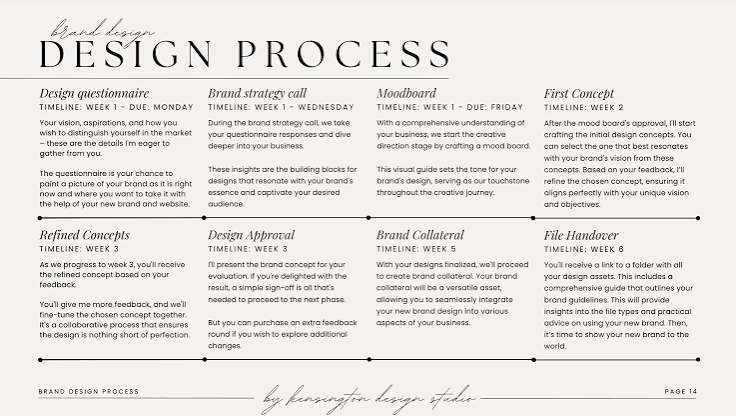
Reviewing concepts is where most projects go sideways. Internal stakeholders comment on colour, typography and photography because those are the things it is easy to have an opinion about, while the decisions that affect performance go unexamined: what the first screen asks the visitor to do, how many steps stand between interest and enquiry, whether the proof points are specific or generic.
A practical fix is to review in two passes. The first pass covers structure and messaging with the design deliberately unstyled. The second covers the visual layer. Splitting them stops a debate about a shade of blue from consuming the meeting in which the navigation should have been settled.
The technical questions that actually matter
Four questions separate a durable build from one that will need replacing in two years. First, what is the plan for migration and redirects? A site that changes its URL structure without a mapped redirect plan can lose a large share of its organic traffic overnight, and recovery takes months. Second, what integrations are in scope, and are they specified precisely? Connecting a form to a CRM is a different job from syncing a product catalogue through an API.
Third, who can edit what after launch? Role-based publishing controls and an approval workflow sound bureaucratic until the alternative becomes clear: a marketing team unable to change a headline without commissioning a change request. Fourth, what happens to performance and security once the project closes? Dependencies age, plugins go unpatched, and an unmaintained site drifts into risk regardless of how well it was built.
These are the questions worth putting to every shortlisted supplier, and firms offering full website design services should be able to answer each of them without deferring to a technical partner. Where a proposal is vague about migration, integration, editing rights or maintenance, the cost of that vagueness usually lands on the client after handover.
Measure the right things after launch
A launch is a milestone, not a result. Benchmark the site before it goes live so there is something to compare against: organic traffic by page group, keyword visibility, enquiry volume and quality, and the engagement figures on the pages that matter commercially. Then look again at thirty, ninety and one hundred and eighty days.
Expect a dip in the first few weeks. Search engines take time to recrawl and reindex a restructured site, and a modest decline that recovers within a month or two is normal. A decline that does not recover usually points to a redirect problem, which is fixable if it is spotted early and expensive if it is not.
Price is a poor proxy for quality, but scope is not
The cheapest proposal is not automatically the worst and the most expensive is not automatically the safest. What differentiates them is how much of the real work is inside the quoted number. Read each proposal looking specifically for what has been excluded: content writing, photography, third-party licences, integration work, training, post-launch support. Once those exclusions are priced in, three wildly different quotes often converge, and the decision becomes a straightforward judgement about who understood the brief best.
That judgement is the one worth making carefully. A well-built corporate site should carry a business for four or five years, and the difference between one that generates enquiries and one that merely exists is decided almost entirely in the weeks before anyone opens a design tool.
