

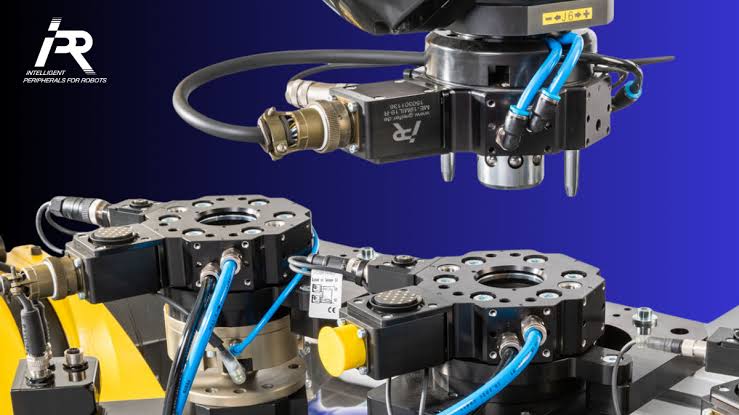
When an automation project underdelivers, the post-mortem rarely blames the robot. Modern arms are accurate, reliable and well supported. What goes wrong sits at the very end of the arm, in the tooling that actually touches the product, and in the assumptions made about it before anyone ordered anything.
It is an easy oversight. Selecting a robot involves clear specifications: reach, payload, repeatability, axes, footprint. Selecting the tooling involves understanding the parts themselves, and parts are messy. They vary in size, finish, weight distribution, rigidity and cleanliness in ways that no datasheet captures.
The part determines the tool
Every gripping method has conditions under which it works well and conditions under which it quietly fails. Vacuum cups are fast, gentle and ideal for flat, clean, non-porous surfaces, and they struggle with textured, perforated, oily or curved parts. Two- and three-finger mechanical grippers handle irregular shapes and heavier items with a secure hold, at the cost of needing a repeatable approach position and a gripping surface that will not mark.
Magnetic tooling is straightforward for ferrous parts and irrelevant for everything else. Soft and adaptive grippers accommodate variable geometry and delicate items, which matters in food handling and consumer goods, but generally trade away speed and precision. Choosing between them requires knowing not just what the part is, but how much it varies across a production run and how it will be presented to the robot.
Cycle time lives in the tool, not the arm
A common surprise during commissioning is that the cell runs well below its calculated throughput. The arm is moving at the speed it was specified to, but each pick includes a vacuum build-up, a gripper actuation and a settle time before the move begins. Those fractions of a second multiply across a shift into a meaningful shortfall.
Tool weight compounds the effect. Every gripper, sensor, cable and bracket counts against the robot’s payload, and a heavily loaded arm must decelerate earlier and accelerate more gently to maintain accuracy. A cell designed close to its payload limit will not achieve its theoretical cycle time, and the shortfall appears only after installation.
Presentation and sensing
Most cells work on the assumption that a part is in a known position and orientation. Where that assumption holds, through fixtures, trays or well-designed feeders, tooling can be simple and fast. Where it does not, the system needs vision, force feedback or compliance to find and adapt to the part, and complexity rises steeply.
The cheapest solution is almost always to improve presentation rather than to add sensing. A well-designed tray or nest can remove the need for a vision system entirely. That tradeoff is worth examining early, because it is far easier to design a fixture at the concept stage than to retrofit one around a commissioned cell.
Specify for the range, not the sample
Tooling is usually specified against a small number of sample parts, typically the ones nearest to nominal. Production presents the full distribution: parts at the edge of tolerance, with flash, warp, surface variation or residual oil. Grip force set for an ideal sample can crush a thin-walled outlier or drop a heavier one.
The corrective is to test against the extremes deliberately — the largest, smallest, heaviest, most deformed and dirtiest parts that will realistically pass through the cell — before the design is frozen. Choosing an End Effector against that full range rather than against a clean sample is the single most reliable way to avoid a cell that performs in acceptance testing and disappoints in production.
Changeover and modularity
Manufacturers that run varied products need tooling that adapts. Quick-change couplers allow an arm to swap tools in seconds, sometimes without operator intervention. Multi-tools carry more than one gripping method on a single head, trading weight for flexibility. Adjustable designs accommodate a family of parts within one tool.
Collaborative robot platforms have made this easier by standardising mounting interfaces and supporting modular integration of grippers, sensors and vision systems, so that peripherals can be added without redesigning the cell. Where a plant expects its product mix to change, that modularity is worth more than a marginal gain in cycle time.
Tooling wears, and it wears fast
End-of-arm tooling is the most heavily cycled part of an automated cell and the most often neglected in maintenance planning. Vacuum cups harden and lose seal. Gripper fingers wear and lose their profile. Pneumatic fittings leak, air filters clog and sensors drift. The symptoms are gradual: an occasional dropped part, then a more frequent one, then a stoppage.
Because the decline is gradual, it is often attributed to the robot or the upstream process rather than to the tool. Scheduled inspection, consumables held in stock and a documented replacement interval prevent most of it, and the cost is trivial against the downtime it avoids. In a well-run cell, the tooling is treated as a wear item with a service life, which is exactly what it is.
